Friday, September 25, 2015

Museum helps to inspire art exhibition

We received this lovely email and some photos the other day...

"I just thought I would send you some photos that were taken of my exhibition on Witchcraft at Stroud College.  I visited the museum in April and spent a long time there and gained a lot of inspiration.  You very kindly allowed me to come back on the Sunday and use your library.  I passed my Foundation Diploma in Fine Art and I am now going to the Arts University Bournemouth to do a degree in Fine Art.

Many thanks,

Rebecca Badsey"

The exhibition looks great, we wish Rebecca well and we're glad that the Museum provided her with help and inspiration!


Thursday, September 24, 2015

Michael Howard

We have just heard some very sad news.  Mike Howard, editor of The Cauldron and author of numerous books, has died recently following a short illness.

As well as being a long term supporter of the museum, he was also a friend to staff here past and present and will be missed.

Sunday, September 20, 2015

Wonderful Straw Crafts workshop


We had a wonderful day of straw crafts at the Museum led by the "Corn Mother" herself - Gillian Nott.  Eight people attended (and one well behaved dog).  They started the day with no knowledge or experience at all and left very adept in this traditional craft.  Many thanks to Gillian and everyone who attended the day.  Everyone enjoyed their day and the event also raised money for the Museum.  We hope to do another similar event and more crafty events in future so watch this space!


Fascinating find inside library book

A visitor to the Museum's library yesterday found a cheque from 1952 inside one of the library books.  The book was called Phallic Worship by George Ryley Scott and the cheque was signed by the founder of the Museum - Cecil Williamson.  An interesting book and an interesting bookmark!


Saturday, September 19, 2015

Witchcraft Play


The following information was provided for us by Out of Joint who have very kindly offered the Museum some free tickets to this play!

Jane Wenham: The Witch of Walkern is by the BAFTA-winning writer Rebecca Lenkiewicz.

The University of Hertfordshire alerted us to the story, and supported a period of research. The resulting play is a gripping, haunting story inspired by real events in a Hertfordshire village in 1712 when the local "cunning woman" was accused of witchcraft.

Rebecca has written a rich and poetic play that explores sex, religion, superstition, nature, and the role of women in society.

TOURING
To theatres in Watford, Leeds, Liverpool, Bristol, Salisbury and London, as well as rural touring in East Anglia and Essex.

Full details including a trailer, tour dates, blogs about witch hunts and more are here:

ABOUT US

Celebrating 21 years this year, Out of Joint is one of the UK’s leading touring theatre companies. Under the artistic directorship of Max Stafford-Clark - former artistic director of the Royal Court Theatre - the company develops and produces theatre that is socially engaged, epic, inquisitive and entertaining. We co-produce with exciting theatres, in this case with London’s Arcola Theatre, and Watford Palace Theatre. Our shows have been seen on six continents.


Recent Artist Research Residency at the Museum

Photograph of the Museum exterior taken by Rachel with a pinhole camera.


Rachel Emily Taylor spent two weeks researching in the Museum.  Here she tells us about her work...

As part of my Fine Art practice-based PhD, I was awarded funding by the Arts and Humanities Research Council to undertake research at the MWM. I was granted 16-days to rummage through the witches’ library, explore the collection and photograph the building during the candlelit session... with my trusty 10 x 8” pinhole camera!

My PhD research is focused on biographical narratives within museums. I am exploring how art practice might communicate a historical character’s ‘voice’, with a particular focus on artefacts and museum captions. The MWM is a rich treasure trove of information that bridges these areas, brimming with stories and magic.

Whilst in the MWM library, I worked my way through Cecil Williamson’s original captions – some water-stained from the 2004 flood – to dig up gems of information and forgotten narratives. During this time I discovered links between Williamson and Edward Lovett, a prominent expert on amulets and author of Magic in Modern London (1925). Williamson collected a number of items from Lovett, including the Mole’s feet charms currently on display in the museum.

Alongside uncovering Williamson’s professional relationship with Lovett, I could not help be captivated by Williamson’s friendship with Joan Wytte. Regulars at the museum with know Joan; her skeleton was kept in the museum until she was reburied by Graham King. Within Williamson’s notes, I discovered profound information on their friendship and his detective work on her history. In his letters, Williamson described Joan as a “Guardian Angel” and she still is. As Helen Cornish wrote, Joan “is very much alive, and living in the Cornish landscape” (2003, p.94).

This photo of Rachel at work in the Museum library was very kindly provided by Tia Cordwell.


To keep up to date with Rachel’s research, visit: www.rachelemilytaylor.co.uk

Below are some photos that she took (the captions are based on ones in the Museum archive but they were re-typed by Rachel on rice paper).


Photograph above taken at Merlin's Cave, Tintagel.


Photographs above show the White Tower in Boscastle and are called "Calling Down the Moon."


Visitor tells us about Dartmoor burial

A visitor last week spoke with Joyce about some experimental archaeology that he had been working on and told us about this fascinating site.
http://www.theguardian.com/science/2014/mar/09/dartmoor-burial-site-bronze-age-history

Friday, September 18, 2015

Straw Craft Day tomorrow (Saturday)

We're looking forward to welcoming those people who booked to come to our day of Straw Crafts.  See you tomorrow!  If you're not one of the lucky ones, keep an eye on our blog to see how they get on and keep an eye open for future events at the Museum.


Museum object takes part in exhibition at Compton Verney

We're pleased to announce that one of the Museum objects will be appearing in an exhibition at Compton Verney in Warwickshire.  To find out more about the exhibition, click on this link and have a look at the promotional texts provided by Compton Verney below.


The object (which was collected earlier this week) is on loan until the end of December.  The object in question is:
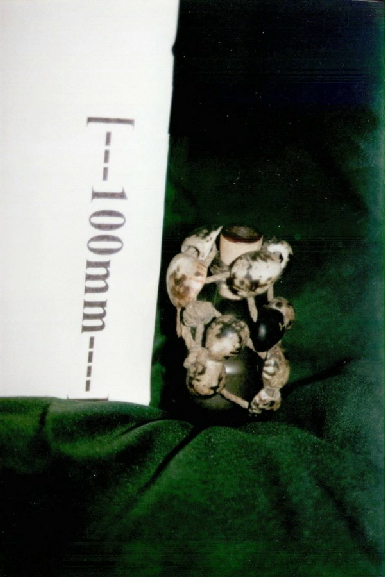
Museum Number: 89
Object Name: Bottles with shells
Physical Description: Small glass bottle half full of mercury and decorated with shells on string.
Material made from: Glass, mercury, shells

And comes with this description on our online catalogue: Original text by Cecil Williamson: 'Mercury - or quicksilver - always regarded as a living mystical metal, beloved of witches and sages. This little bottle of mercury gay with its ring of small shells was used by a wise woman living in Penzance in about 1905. She earned money by telling the weather from it for fishermen. A Newlyn-based artist acquired this small bottle and treasured it as a totem, or house spirit charm which he swore brought him luck. He said the wise woman's name was Janie Rowe or Rouse, he was not quite sure which was the correct name.'


We're really pleased that this wonderful Museum object will be seen by a different audience and in a different context.


Upcoming play in Boscastle

Several members of the Museum Team are going - hope to see you there!


Memento Mori & Folklore - The Rather Grim Habit of Keeping Skulls

This interesting article by Pollyanna Jones includes an image of the Museum.
http://pollyannajones.hubpages.com/hub/The-Rather-Grim-Habit-of-Keeping-Skulls

Wednesday, September 09, 2015

New Japanese Guide Available!

Many thanks to Akira Kusunose for his translation of the Museum guide into Japanese.


We hope to see many more Japanese visitors over coming years!

Object(s) of the Month: Coin Magic

Coins in the Collection

Coins were widely used in magic down the centuries and they continue to be carried as charms by people today.  Coins as magical objects often derive their power from the planets (especially the moon), angelic powers, saints, the King or Queen, or from their inherent material potency (gold, silver, copper).  The ‘lucky coin’ is the most common form of coin magic today: this was often a sixpence found in Halloween cakes (used in divination) and Christmas puddings, where it was then kept or carried as a lucky token.

Some coins are inherently potent.  In England, ‘touch pieces’ or ‘angels’– coins given by the monarch at a special ceremony – were used as talismans to counter scrofula (an intensely painful skin condition).  These special pieces were applied to the areas affected, and then later hung around the neck on chains.  The appearance of angels (usually the Archangel Michael) on these coins may have increased their potency, given the importance of angelic powers in ritual magic.  This Elizabethan silver sixpence in the Museum collection (note the hole) may have had a similar use.

Object No. 2331

Coins were 'set apart' as lucky or efficacious by simply bending them (see below):  this probably goes back to the medieval  'English custom' where coins were bent in prayer to a saint, and then the same bent coin deposited at the saint's shrine when the donor went on pilgrimage.  Bending coins later became a means of remembrance, but the idea of bending or breaking something of value for ritual purposes (a sword or shield for example) goes back as far as the Bronze Age.  

Object No. 2335.  A bent (and perforated) gold piece from the reign of Edward VI (1547 - 1553)

In the 1500s, Theophrastus Paracelsus used gold in many of his crafted pieces, fashioned in the shape of coins.  He treated a client for another skin disease, leprosy, using balsam, aurum potabile (liquid gold) together with a small coin of beaten gold inscribed with astrological symbols:

“Let this kinde of Sigil be made of pure Gold, and wrought into a Lamen in the hour of Saturn, but the Characters ought to be ingraven in the hour of Sun, when Moon is in and Sun in the same sign; which usually happens in July.”

Once engraved, the sigil was activated, but it only had a limited time-span:  “It ought to be renewed every year in July, for this Sigil loseth its force in a year”. The movement of Saturn, moon and sun, out of a particular alignment ended the efficacy of the sigil, reminding the patient of the origin of its power. When activated however, the entire object was efficacious: it was recommended that the sigil should be steeped in wine which the patient then drank.

This early remedy is echoed by a folk charm collected by Cecil Williamson in the twentieth century which links the feminine with both the moon and silver:

“Silver water, the ever popular cure all drink. The silver coins placed in the water must have an impression of a female head on them. The[se] ... were used by Charlie Wallace, of Rockcliffe, near Carlisle. Charmer Wallace charged a fee of a penny a glass and the coins had to be left in the water overnight. The water had to be drunk as the dawn sun came up.  A case of sun up water down.”  [CWOLC 7095]

Object Nos. 2346 and 2338.  The first depicts the female form of  'Provedentia', c. 276-282 CE.  

The immersion of coins in water overnight by the light of a new moon was also efficacious in the treatment of cattle, as this charm from twentieth century Dorchester shows:

“A small hoard of Roman coins, discovered when and where goodness only knows. But we do know that this hoard was treasured and used by a wise woman of Dorchester for making her cattle and horse medicine. Her method was to get smithy water and immerse the coins, in a little cloth bag, in the water over night at the time of the new moon.” [CWOLC 8040]

A selection of coins discovered in the Museum this year may turn out to be the charmed coins collected by Cecil Williamson in the mid-twentieth century:


From the high magic of the early modern period, to the folk remedies of the rural South West, it is clear that the planets were hugely significant in coin magic.  These charms all shared the same notion that the power of the moon and other cosmic forces could be harnessed and impressed into small pieces of metal for the protection and healing of human beings. 

Sources

CWOLC (Cecil Williamson Object Label Collection), Museum of Witchcraft & Magic, Boscastle Cornwall
7095, 8040

Herbert Appold Grueber, Handbook of the Coins of Great Britain and Ireland in the British Museum, (London: 1899)

Peter Hewitt, ‘Making and using magical objects in early modern England: apotropaia and objects of folk-belief in the Shakespeare Birthplace Trust collection’, in Hewitt The material culture of Shakespeare’s England: a study of the early modern objects in the museum collection of the Shakespeare Birthplace Trust, Unpublished Ph.D thesis, 2015.

Ralph Merrifield, The Archaeology of Ritual and Magic, (Batsford: 1987)

Theophrastus Paracelsus, Of the supreme mysteries of nature. Of [brace] the spirits of the planets. Occult philosophy. The magical, sympathetical, and antipathetical cure of wounds and diseases. The mysteries of the twelve signs of the zodiack. / Englished by R. Turner, philomathes. (London: 1655)

Sunday, September 06, 2015

Winners of Children's Art week revealed

It has been a couple of months since our second children's art week drawing competition and it is time to reveal the winners.

Our recent refurbishment of the Images of Witchcraft gallery and our current temporary exhibition of Jos Smith's illustrations inspired this year's theme which was witches in fiction, fantasy and folklore.  We asked our younger visitors to the Museum to draw us an image of a witch and we have had some lovely works of art handed to us in the booth.

This picture seems to have been inspired by the gingerbread house in the story Hansel and Gretel...

This tiny witch was drawn by an unnamed visitor...

This witch is called Derek and was drawn by Yseult aged 3...


This colourful picture seems to show a witch performing some sort of spell (perhaps with a dragon?) and was drawn by Bruno...

This witch (called Ursula) was drawn by Craig...


The Top Three Winning Pictures
In third place this beautiful picture by Saskia Dunn aged 12 with the title "Don't mess with the witches".  If anyone knows Saskia please can you contact the Museum as we have been unable to contact her about her prize.


In second place this wonderful witch with multi-coloured hair by Nissa aged 9.


And in first place Isabel Cudby of Truro who said "I have made a witch up in my head."

Prizes will be going out to the winners soon and the winning pictures will be on display in the Museum until next year's competition.

Many thanks to everyone who entered.  Keep an eye out for next year's competition!


Saturday, September 05, 2015

Winter opening times this year

We often hear from visitors that they tried to visit the Museum in winter and were disappointed that we were closed.  After being open every day during the summer season, the Museum has traditionally closed from October 31st until April 1st.  This time of year, Cornwall is quite quiet and it provides us with an opportunity to do maintenance, cleaning and refurbishment.  Having said that last year, we tried opening at winter and it was quite successful so we will be doing it again.  Hope to see you here!

Our plans for winter opening 2015-2016 are:
Open weekends in November (closed weekdays) 12-5pm (last entry at 4.30pm)
Closed in December until Christmas holidays.
Open every day from December 19th until January 3rd (inclusive).  Opening hours each day will be 12-5pm (last entry 4.30pm).  Closed Christmas Day.
Closed from 4th January until April 1st.

If you are unsure about opening hours, please contact the Museum.  Any changes to these dates will be posted on this page and displayed outside the Museum.


Talk in Nottingham went well

Judith and Peter Hewitt (co-managers of the Museum) delivered a talk on Wednesday evening for Nottingham Empyrean Pagan interest group http://www.nottinghamempyrean.co.uk/.

We were really pleased to be invited and talk about the Museum to an audience that was (mainly) unfamiliar with the Museum.  We feel like we stimulated interest and enthusiasm for the Museum.  Thanks for the wonderful reception!

The talk was held in the Theosophical Hall (hence the There is no Religion higher than truth behind Peter on the photo below).


Above: Judith and Peter with the lovely people from Nottingham Empyrean (and Yoda the cat).